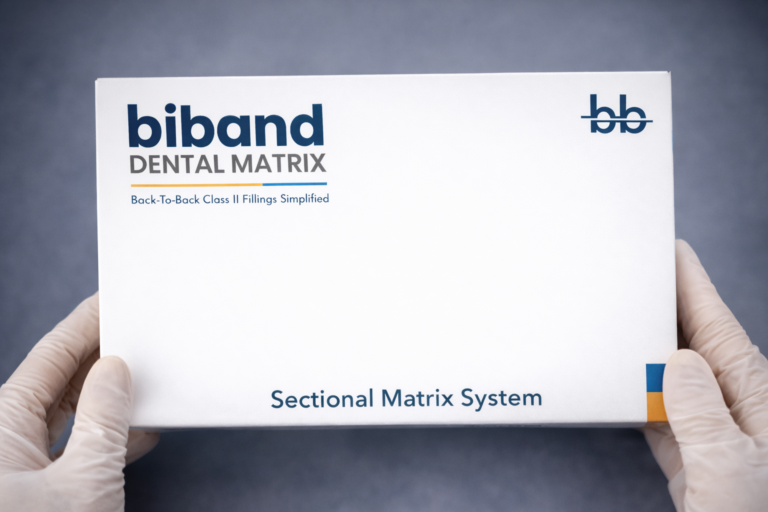
Biband simplifies
“Message from Dr. Lance Gordon, Founder and Inventor”
I was always frustrated when I saw a full quadrant of back-to-back fillings on my schedule. I wanted to know if it was just me, so I surveyed 415 dentists, and most of them felt the same way. What they kept coming back to wasn’t the restorations themselves, but managing all the separate components around adjacent teeth. The wedges, the matrix bands, and the rings all competing for space.
As a dentist, you know how tedious and technique-sensitive this can be. Matrix bands slip or crumple. They move when you don’t want them to. The ring becomes difficult to place because the bands are in the way. You’re hoping you end up with a tight contact. And if you restore one tooth at a time, removing the band and wedge often causes bleeding into the adjacent tooth, which sets you back before you even start the next restoration.
That frustration led me to a simple question. How could all of these separate parts be combined into one system that’s easier to place and less technique-dependent? Over the years, I worked through multiple prototypes and refinements until it finally became the design you see today, the biband matrix.
My goal is straightforward. I want back-to-back restorations and full-quadrant fillings to be faster, more predictable, and easier for you.
 Biband Matrix™ | Back-to-Back Class II Fillings Simplified